
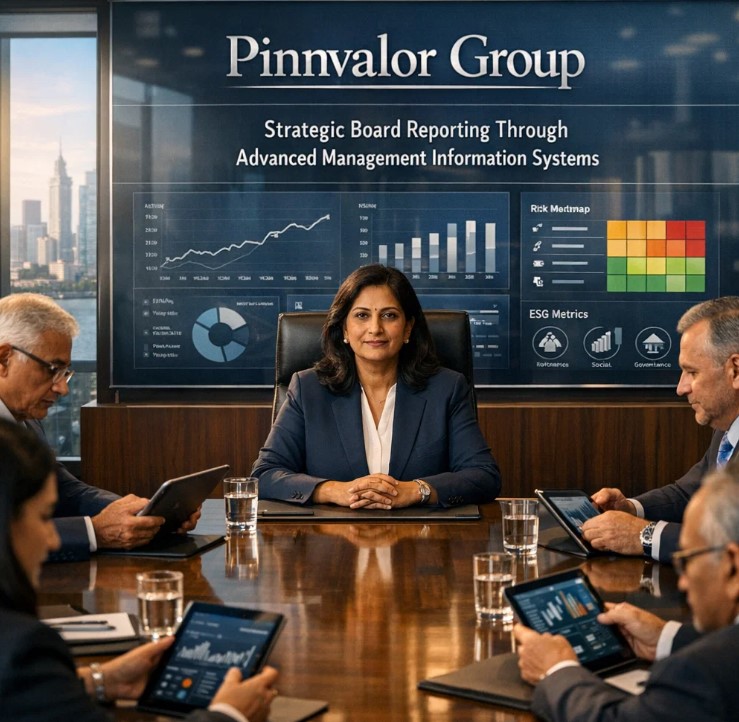
Strategic Board Reporting Through Advanced Management Information Systems
In today’s governance landscape, board members are no longer passive reviewers of quarterly financials. They are strategic stewards responsible for long-term value creation, risk oversight, capital allocation, digital transformation, ESG accountability, and stakeholder confidence.
Can your board anticipate risks before they materialize?
When performance, risk, and ESG converge in one intelligent framework, the board stops reacting to outcomes and starts architecting the future.
Yet many boardrooms still rely on static presentations, backward-looking summaries, and fragmented data. Advanced Management Information Systems (MIS) transform reporting into a strategic intelligence framework that shapes board-level decision-making.
1. The Evolution of Board Reporting
Traditional board reporting focused primarily on historical performance and compliance updates. However, modern governance demands forward-looking intelligence and integrated oversight.
Traditional Focus:
- Historical financial performance
- Budget vs. actual comparisons
- Compliance summaries
- Basic KPI dashboards
Modern Board Expectations:
- Forward-looking insights
- Scenario modeling and stress testing
- Enterprise risk heatmaps
- Real-time performance tracking
- Strategic KPI alignment
- ESG and sustainability metrics
- Predictive analytics
Boards today ask: Where are we heading? What could disrupt us? Are we allocating capital efficiently? An advanced MIS must answer these questions clearly and proactively.
2. What Makes MIS “Advanced” for Board Reporting?
An advanced MIS is not merely a reporting tool — it is a decision architecture that aligns data with enterprise value creation.
1. Strategic Alignment
The system must align KPIs with corporate strategy, long-term value drivers, risk appetite, and capital allocation priorities.
Every metric reported to the board should answer: How does this influence enterprise value?
2. Forward-Looking Intelligence
- Rolling forecasts
- Sensitivity analysis
- Scenario planning (best, base, stress case)
- Predictive modeling
Instead of reporting what happened, it anticipates what could happen.
3. Integrated Risk & Performance View
- Financial performance
- Operational metrics
- Enterprise risk exposure
- Compliance posture
- ESG impact
Integration eliminates silos and strengthens governance oversight.
4. Real-Time Data Architecture
- ERP system integration
- Cloud-based data consolidation
- Automated reporting workflows
- AI-driven anomaly detection
This reduces manual intervention and enhances accuracy.
5. Visual & Insight-Driven Design
Board members require clarity, not operational overload.
- Trend-focused dashboards
- Material deviation highlights
- Executive-level summaries
- Visual storytelling frameworks
3. Core Components of Strategic Board MIS
A. Financial Intelligence Layer
- Revenue growth analysis
- Margin trends
- Working capital efficiency
- Cash flow projections
- Capital expenditure tracking
- Return on Invested Capital (ROIC)
B. Strategic KPI Layer
- Market share analysis
- Customer acquisition cost vs. lifetime value
- Innovation pipeline tracking
- Digital transformation milestones
- Competitive benchmarking
C. Risk & Governance Layer
- Enterprise risk heatmaps
- Cybersecurity posture monitoring
- Regulatory compliance metrics
- Litigation exposure tracking
- Internal control effectiveness indicators
D. ESG & Sustainability Reporting
- Carbon footprint metrics
- Social impact indicators
- Governance standards monitoring
- Diversity, Equity & Inclusion metrics
- Supply chain sustainability measures
4. Strategic Impact on Board Decision-Making
Better Capital Allocation
Advanced analytics support expansion decisions, M&A evaluations, and divestment strategies with data-backed confidence.
Enhanced Risk Oversight
Predictive risk models allow boards to identify vulnerabilities early, stress-test liquidity, and monitor covenant compliance.
Faster Strategic Pivoting
Real-time intelligence enables quicker responses to market disruption and competitive shifts.
Improved Investor Confidence
Transparent, structured reporting strengthens governance perception and valuation credibility.
5. Common Challenges in Board-Level MIS
- Information overload
- Lack of system integration
- Inconsistent KPI definitions
- Manual spreadsheet-driven reporting
- Poor data governance controls
- Weak linkage between strategy and metrics
The result is often information abundance but insight scarcity.
6. Designing an Effective Board-Centric MIS Framework
Step 1: Start with Strategy, Not Software
Define strategic objectives, value drivers, and risk appetite before selecting technological solutions.
Step 2: Define Board-Level Materiality
Include only metrics that influence enterprise risk, strategic direction, or value creation.
Step 3: Establish Strong Data Governance
- Standardized KPI definitions
- Single source of truth
- Automated validation controls
- Secure access management
Step 4: Build a Tiered Reporting Structure
- Level 1: Strategic executive summary
- Level 2: Analytical deep dive
- Level 3: Supporting data repository
Step 5: Integrate Predictive & AI Capabilities
Leverage machine learning forecasts, anomaly detection, and automated commentary to convert data into board-ready insights.
7. The Future of Strategic Board Reporting
- Real-time secure board dashboards
- AI-generated strategic summaries
- Integrated ESG-financial modeling
- Scenario simulation environments
- Interactive decision-support platforms
Conclusion: From Reporting to Strategic Governance
Strategic board reporting is no longer about presenting numbers — it is about enabling governance excellence.
An advanced MIS converts operational data into strategic clarity, integrates risk with performance, and empowers proactive decision-making.
Organizations that treat MIS as a strategic governance asset — not merely an IT tool — build boardrooms that are informed, agile, and future-ready.