
Distressed Company Valuation: Liquidation Value vs. Going Concern Value
In the world of corporate finance and restructuring, valuing a distressed company is a nuanced exercise that goes far beyond traditional valuation techniques. When a business faces financial instability, declining performance, or insolvency risk, the focus shifts from growth potential to value preservation and recovery. At the core of this evaluation are two key approaches: Liquidation Value and Going Concern Value.
Do assets tell the full story, or does future potential matter more?
Liquidation sets the floor, but survival unlocks the ceiling.
1. Understanding Distress: When Valuation Becomes Complex
A distressed company is one that struggles to meet its financial obligations or sustain operations. Common indicators include:
- Continuous operating losses
- Negative cash flows
- Breach of debt covenants
- Liquidity constraints
- Insolvency or bankruptcy risk
In such scenarios, uncertainty dominates, making valuation both critical and challenging.
2. Liquidation Value: The Floor of Valuation
Liquidation Value represents the net amount that can be realized if the company’s assets are sold and operations are discontinued.
Key Features:
- Assets are sold individually
- Distressed or discounted sale values
- Focus on creditor repayment
- No consideration of future earnings
Types of Liquidation:
- Orderly Liquidation: Sale over time to maximize value
- Forced Liquidation: Quick sale at steep discounts
Formula:
Liquidation Value = Realizable Asset Value – Liabilities – Liquidation Costs
When Applicable:
- No viable turnaround strategy
- Business operations are unsustainable
- Insolvency proceedings underway
Insight: Liquidation value acts as the minimum benchmark for recovery.
3. Going Concern Value: Capturing Survival Potential
Going Concern Value assumes that the company will continue operating and generate future cash flows.
Key Features:
- Based on future earnings potential
- Includes restructuring strategies
- Considers intangible assets
- Higher uncertainty and risk
Valuation Methods:
- Discounted Cash Flow (DCF)
- Comparable Company Multiples
- Precedent Transactions
- Scenario Analysis
When Applicable:
- Business has a viable core
- Turnaround plan exists
- Investor or lender support available
Insight: Going concern value reflects the potential upside of the business.
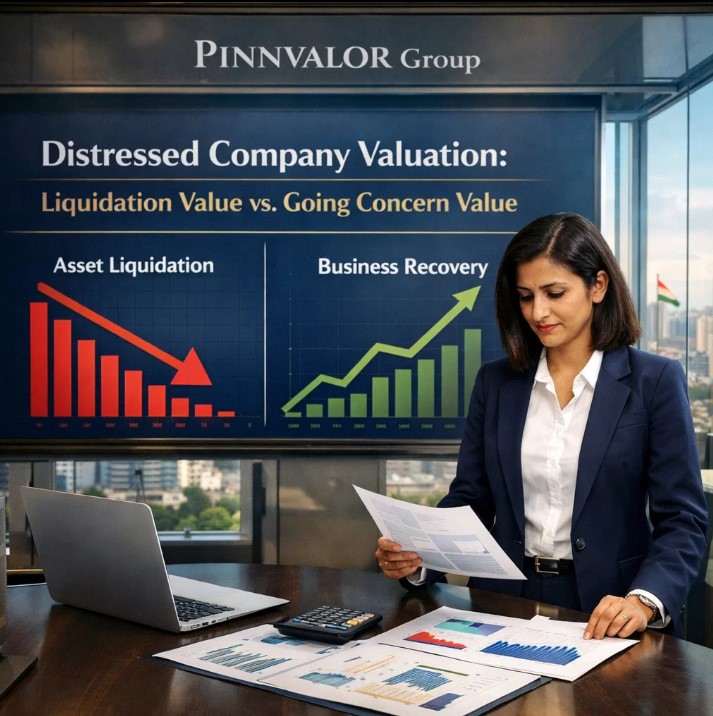
4. Liquidation vs. Going Concern: Key Differences
- Business Status: Closed vs. Continuing operations
- Focus: Asset sale vs. Future cash flows
- Time Horizon: Short-term vs. Long-term
- Value Outcome: Lower vs. Potentially higher
- Risk: Lower vs. Higher uncertainty
5. Decision-Making: Which Approach to Use?
The key question is:
Is the company worth more alive or dead?
Factors to evaluate include:
- Operational viability
- Financial restructuring feasibility
- Market conditions
- Availability of funding
If going concern value exceeds liquidation value, restructuring is preferred. Otherwise, liquidation may be the better option.
6. Role in Real-World Applications
- Insolvency Cases: Helps decide liquidation vs. resolution
- M&A Deals: Guides distressed acquisitions
- Debt Restructuring: Assists creditor negotiations
7. Challenges in Distressed Valuation
- Unreliable financial data
- Market volatility
- Uncertain recovery timelines
- Stakeholder conflicts
8. Conclusion
Distressed company valuation requires balancing conservative and optimistic perspectives. Liquidation Value provides a safety net, while Going Concern Value captures future potential.
A comprehensive approach considers both, enabling stakeholders to make informed decisions in uncertain and high-risk environments.